From the dust is an exciting project that uses new technologies to bridge the present to the past.
The Dust Bowl: A Human-Made Ecological Catastrophe…
“And then the sky just turned black. You couldn’t see your hand in front of your face. The dust got in your teeth, your clothes, even your prayers.”
— Imogene Glover, Oklahoma Panhandle settler
The Dust Bowl was a defining moment in American environmental history—not because it was inevitable, but because it was preventable. Its legacy, preserved through voices of those who endured it, reminds us that the land remembers. And it holds us accountable.
The Dust Bowl of the 1930s was a human-made ecological disaster. Drought and poor land management combined to devastate the Great Plains, creating massive dust storms that displaced millions. States most affected included Oklahoma, Texas, Kansas, Colorado, and New Mexico.
Dust storm, Baca County, Colorado, 1930s
“And then the sky just turned black. You couldn’t see your hand in front of your face. The dust got in your teeth, your clothes, even your prayers.” — Imogene Glover, Oklahoma Panhandle
“We were treated like dirt. They thought we was stupid just ‘cause we came from the Plains. But we’d seen more than most. Lost more, too.” — Migrant worker in California (Todd Collection)
Over 2.5 million people fled the Dust Bowl, mostly toward California. Dust pneumonia, hunger, and poverty shaped the migrant experience.
Migration routes from Dust Bowl to California, 1930s
The Dust Bowl inspired iconic works like Steinbeck’s The Grapes of Wrath, Dorothea Lange’s photography, and Woody Guthrie’s protest songs.
“Migrant Mother” (1936) by Dorothea Lange
Excerpt from Ken Burns’ The Dust Bowl documentary
Today, as megadroughts and climate change loom, the Dust Bowl reminds us that ecological disasters are often human-made—and preventable. Conservation strategies born in the 1930s remain relevant: sustainable farming, land stewardship, and federal intervention can protect against similar catastrophes.
Lou Andreas-Salomé (1861–1937) was a Russian-born intellectual, writer, psychoanalyst, and muse who lived a radical, boundary-defying life at the intersection of philosophy, literature, and psychoanalysis. Her social circles read like a who’s who of late 19th and early 20th-century European cultural elites.
Early Life:
Born February 12, 1861, St. Petersburg, Russia, as Louise von Salomé as the daughter of a Russian army general of German descent; raised in an intellectually rich, German-speaking household within the Russian elite. Exceptionally well-educated for a woman of her time. Studied philosophy, theology, and art history in Zurich and later in Leipzig and Berlin. She was mentored by the Dutch pastor Hendrik Gillot, who fell in love with her despite being married and twice her age.
In her early 20s, she left Russia with her mother and began traveling across Europe. Her intellectual independence and charisma soon drew in prominent thinkers of the era.
Social Circles
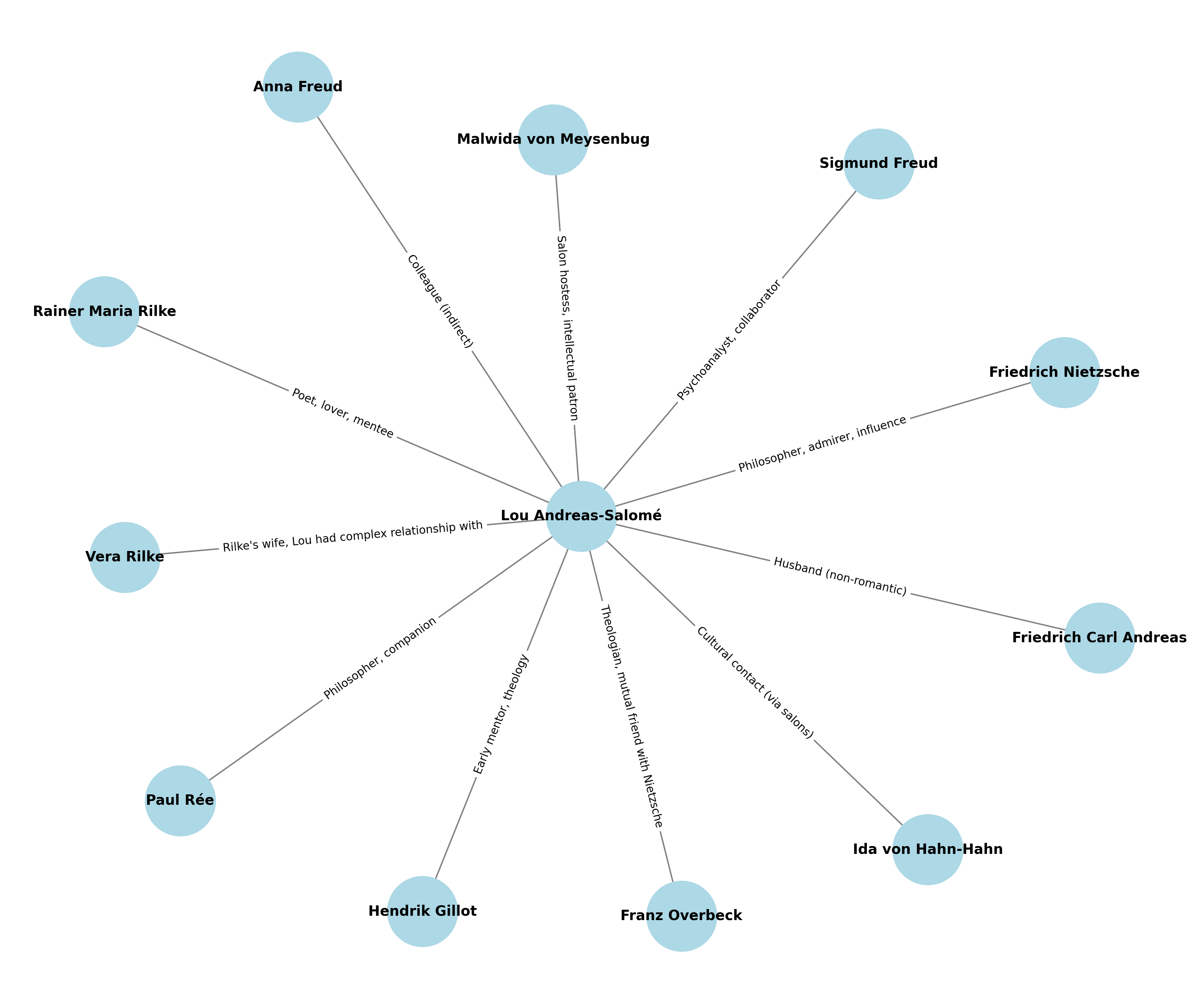
Lou Andreas-Salomé’s social and intellectual network. Each connection reflects her multifaceted relationships—with philosophers like Nietzsche and Rée, psychoanalysts like Freud, and poets like Rilke—illustrating her pivotal role in the cultural and psychological transformations of her era.
Friedrich Nietzsche
Met Nietzsche in 1882 through Paul Rée.
Formed a legendary (and controversial) intellectual trio with Nietzsche and Rée in Italy.
Nietzsche fell deeply in love with her and proposed (twice); she declined.
Their bond sparked his later philosophical bitterness toward women, and possibly influenced Thus Spoke Zarathustra.
Salomé admired his mind but refused romantic entanglement, preferring a “Platonic” companionship.
Paul Rée
Philosopher and close friend.
Planned to live in a communal, celibate intellectual household with Lou and Nietzsche.
Deeply in love with her, and devastated by the fallout from the Nietzsche conflict.
Rainer Maria Rilke
Began an intense affair in 1897 when he was 21 and she was 36.
She introduced him to Russian literature (Tolstoy, Dostoevsky), revised his name from “René” to “Rainer,” and helped him refine his poetic style.
Their relationship had a maternal and erotic dimension.
Continued correspondence and intellectual companionship long after the romantic relationship faded.
Sigmund Freud
Met Freud in 1911 and became one of the first female psychoanalysts.
Attended meetings of the Vienna Psychoanalytic Society.
Freud admired her deeply, calling her the “only woman who understands” psychoanalysis.
Their correspondence was rich and philosophical; she was one of Freud’s most articulate interlocutors.
Other Connections
Henrik Ibsen: Admired his plays and ideas on individuality and gender.
Richard Wagner and Cosima Wagner: She moved in similar cultural circles, though her relationships with them were not personal.
Anna Freud: Though less close, Salomé’s presence influenced the next generation of psychoanalysts.
Franz Overbeck and Malwida von Meysenbug: Intellectuals with whom she corresponded and traveled, part of the German progressive intelligentsia.
Lou’s writings included Im Kampf um Gott (1895): A novel about the crisis of religious belief and the search for meaning. Ruth (1895) and Fenitschka (1898): Proto-feminist texts exploring female autonomy and eroticism. Der Mensch als Weib (1899): On femininity and the cultural role of women; anticipates ideas later explored by de Beauvoir.
References:
Freud, Sigmund, and Lou Andreas-Salomé. Letters. Edited by Ernst Pfeiffer. Cambridge, MA: Harvard University Press, 1966.
Young-Bruehl, Elisabeth. Anna Freud: A Biography. Yale University Press, 2008.
Between 1918 and 1933, the arts and sciences exploded throughout Europe — in large part due to the the nurturing and culturally rich environment of the Weimar Republic. Ideas born from within the Republic seeped into the worlds outside of it.
Examining the overlapping lives of artists through their physical movement and letter trails during this period paints a picture that illuminates history from a unique perspective. Digitally mapping these networks, we begin to answer questions about what they look like; how far they reach; how they develop and the sphere of their influence.
Villages Divided — Life Along the Line of Demarcation in WWII, Vichy France
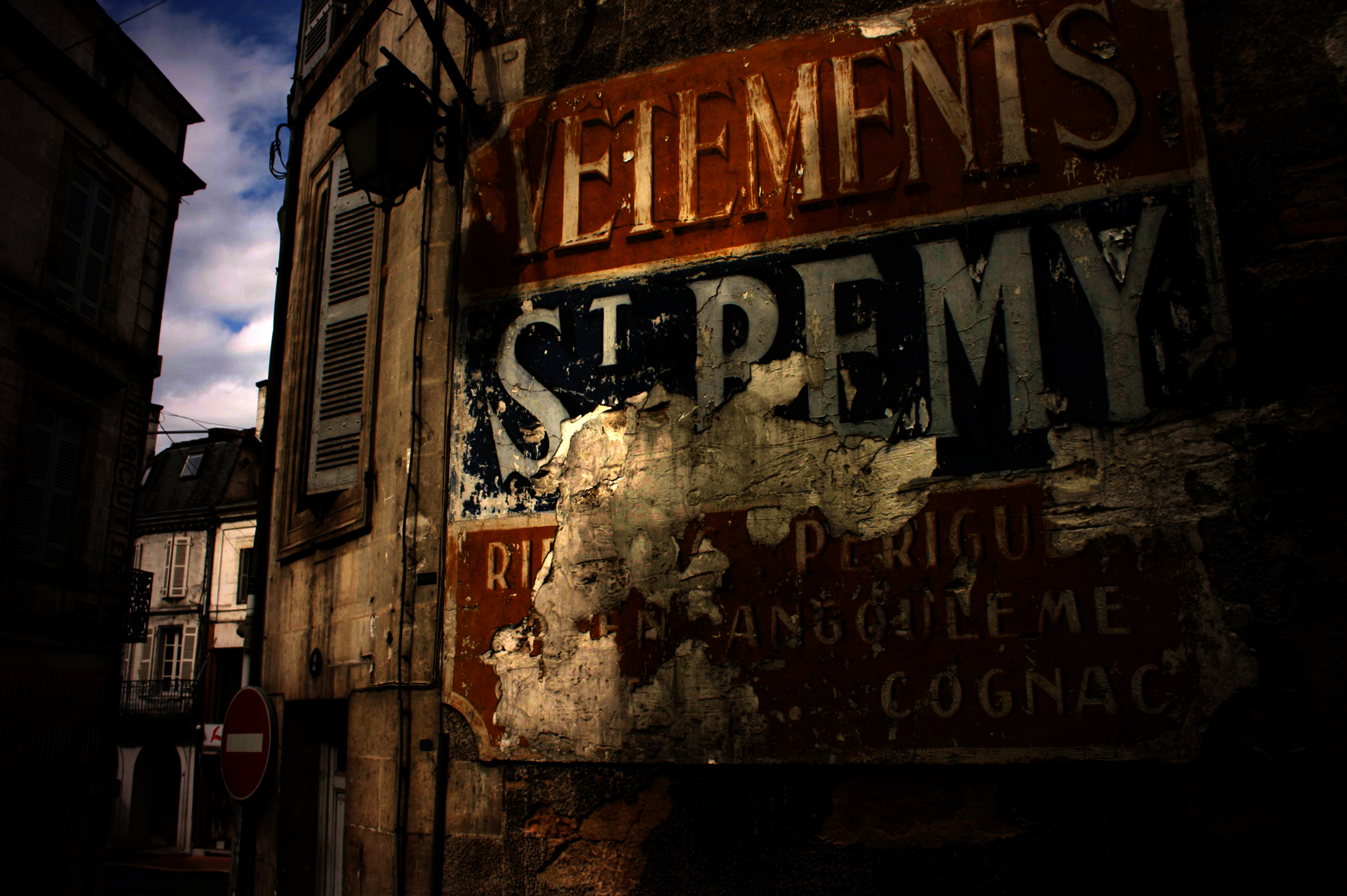
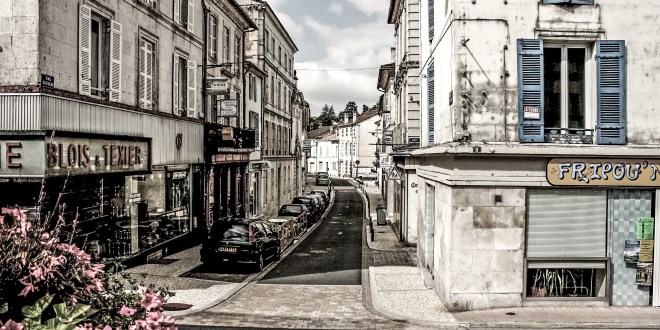
Riberac, France, 2010 — photo J Lamb
In 1940 German troops erected a line of demarcation through the already divided country of France. The line was set up to the west side of villages in occupied territory, such as Montapon, Echourgnac, and La Jemaye. To cross the line at any given time, a person had to have what was called a pasisser-passer. It was very difficult to obtain. Those caught trying to cross the line who did not possess the correct documentation were arrested and imprisoned. The sentence for such an offense was fifteen days, for men. It was slightly lighter for women who were only imprisoned for ten days.
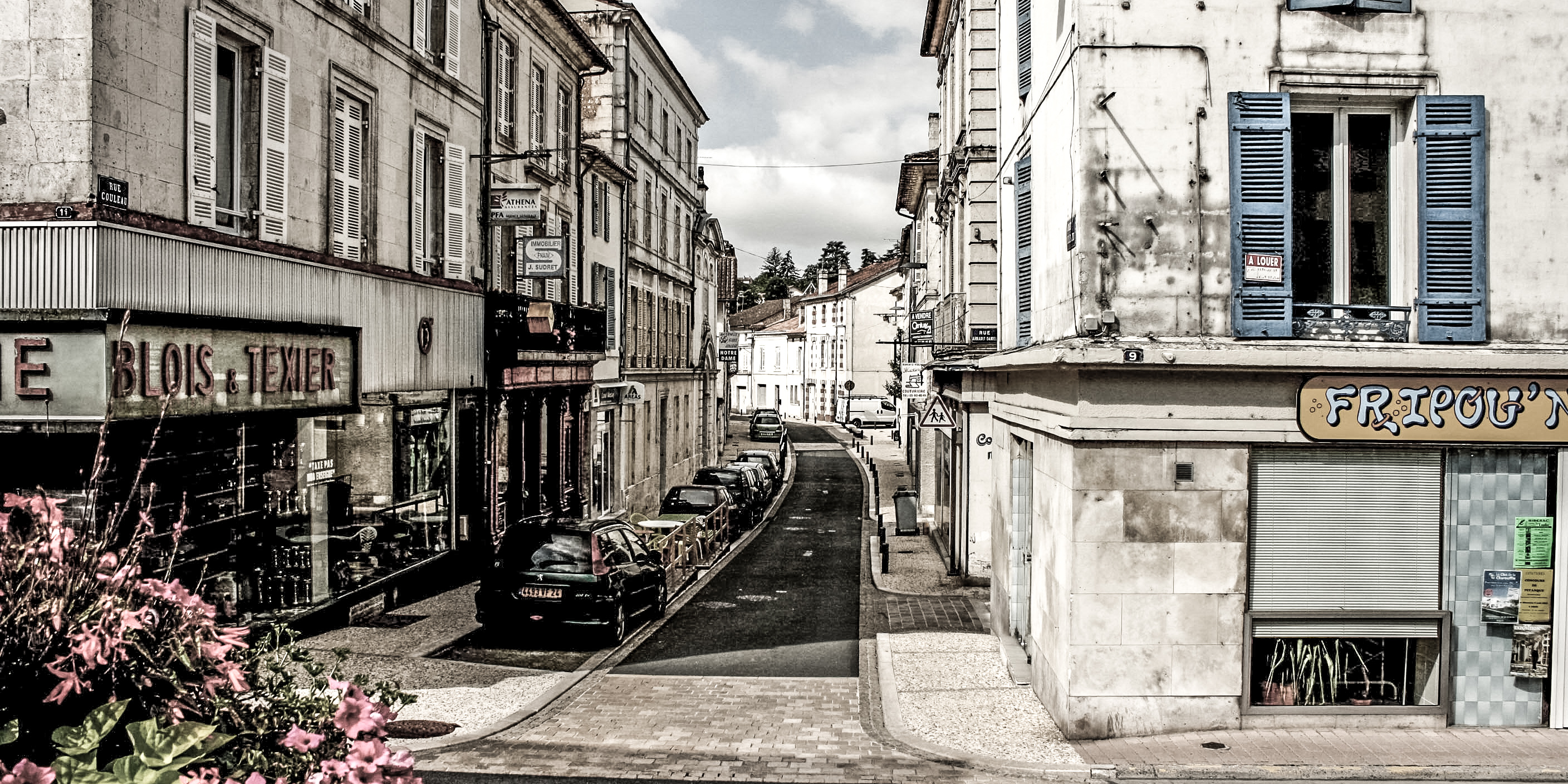
Saint-Martin-de_Riberac, June, 2010, Photo J Lamb
The line of demarcation represents only a fragment of what life was like for those residing in “unoccupied” Vichy France. Restrictions over travel had a crippling effect. Business could not be conducted as usual; the most innocent act could be misconstrued. This could land a person before a death squad or in prison — which usually resulted in being put on a train to any number of concentration camps, beginning with those in Paris. As the war waged on, conditions in Vichy France deteriorated.
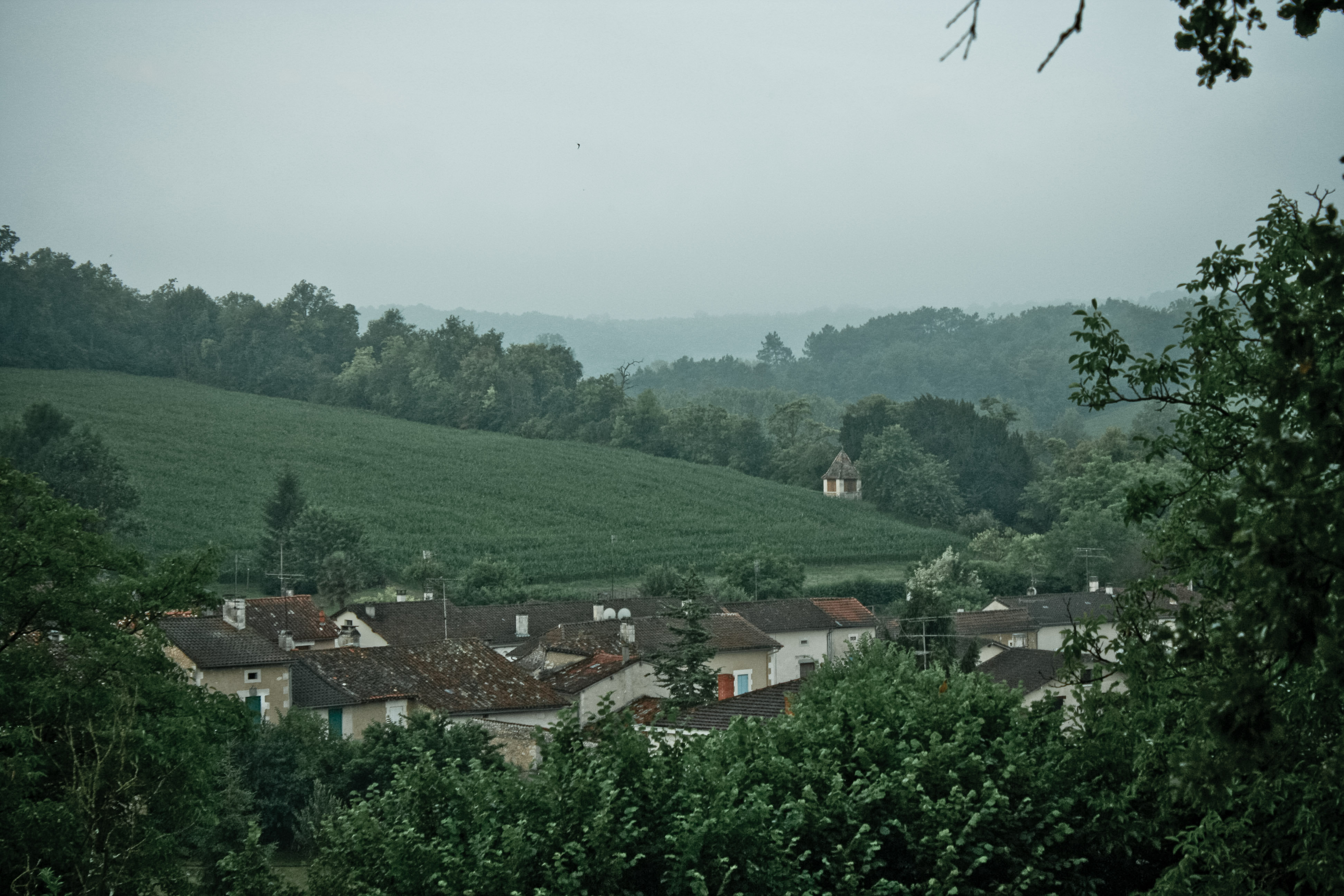
The village of Riberac (far upper right corner)
Ironically, occupied France was in a much better shape, in spite of all the devastation, than the unoccupied territory.[1] No matter how benign it may seem, this line of division is powerful; it shaped France’s future. To present day, some villagers living along the divide acknowledge this in a variety of ways; occupants residing in villages once situated in occupied France are less willing to discuss the past than those in unoccupied territory. Or when finding someone willing to share their story, the details and sentiment contrast sharply with those one hears told about life on the Vichy side. In an occupied village a story was told about a Nazi soldier who entered a man’s home demanding a raincoat. A few days later, the soldier returned the coat clean and neatly folded. “The German’s were so efficient! They believed in order.”[2] Some of the reasons for contrasting sentiment may hinge on the way the onset of the war played out.
On the 3rd of September 1939, just five months after the end of the Spanish Civil War, together with Britain, Australia and New Zealand, France declared war on Germany. Only six weeks later that France capitulated to the German invasion. French humiliation cannot be overstated. This was a stunning defeat – particularly since before the war the French army was considered the most powerful in Europe.[3] The scale of the crisis caused by capitulation was massive. National identity proudly rested on the republics long-held motto, liberté, égalité, fraternité (liberty, equality, fraternity) was at steak. The French army was not given a chance to prove itself in victory or defeat, at the same time French citizens were cast a new role. Over night, under German rule, a new French identity was born that revered travail, famille, patrie (work, family, fatherland).
Further destruction of French identity happened just as swiftly. A Nazi invasion resulted immediately in a divided France. In a matter of days the nation was fragment in ways that left and lasting wounds. The line of demarcation still remains in people’s minds as a permanent marker that separate those who suffered more from those who suffered less. Those who complied with the enemy demands from those who resisted them. The story about the raincoat erases traces victimization. And, demonstrates each French citizen touched by the war possessed at least one freedom, one could interpret what was happening in their world. For the man with the raincoat, escape from an organized regime such as the Nazi’s must have seemed impossible. Where he lived, occupied territory was under the direct rule of German forces where most French citizens are known for having remained rather subdued, an altogether different scenario was unfolding and attitudes were anything but subdued.
It is in unoccupied France, more fractures in identity were created when those in power were replaced with the Vichy regime made up of French citizens whose allegiance was clearly aligned with German rule. The new Vichy government did not have to run for election. As a result, it was devoid of a political platform from where its ideologies were defined. Without a basic political theory, some observers have denied that the Vichy regime had any theoretical basis at all and have claimed that it was no more than a creature of accidental circumstances.[4] Some say the Vichy was in part the product of social and economic conditions that existed in France as a result of the First World War, during which France split more blood than any other nation.[5] This is the same France where one could observe, in the last years, before 1939, the growth of many youth groups, young Radicals, young Socialists, young Catholics, young rightists and so on.[6] Fueling some of these groups was a rising tide of immigration from Italy and in particular Spain, as a result of the end of the Spanish War.
In any case, the new government regime acted in accord with German desires and was not a free agent, but a sharply circumscribed instrument created by the German overlords in Paris whose desire was to push from one collaboration measure to another.[7] The German aspiration for collaboration was somewhat cultivated by and made easier by France’s recent past.
The social and economic conditions of prewar France show a demographic nightmare rife with imbalances. For instance, twenty five percent of the entire population consisted of the age group of fifty to eighty.[8] Like the politicians in Paris who did not find themselves able to fulfill the desired changes wanted within such a polarized country, French youth was searching for something meaningful to define their lost generation. If the Vichy government was not appealing, the alternative option for those living in unoccupied was to join la Resistance, or what is commonly referred to as la maquis, meaning, “wild.” The name drew its inspiration from, “La Double,” the forest that still encapsulates the department, La Dordogne, with its prefecture in nearby, Périgueux.
La Double was a largely untamed forest. It had few roads making access by vehicle was really difficult. Walking in was difficult, too, because the undergrowth was thick. Add weapons to a sojourn, ammunition, radios, what-have-you — you still do not know exactly where you are going because you do not know where la maquis are hiding. La Double provided a safe home to the Resistance. The forest, like those serving in it, was wild. [9]
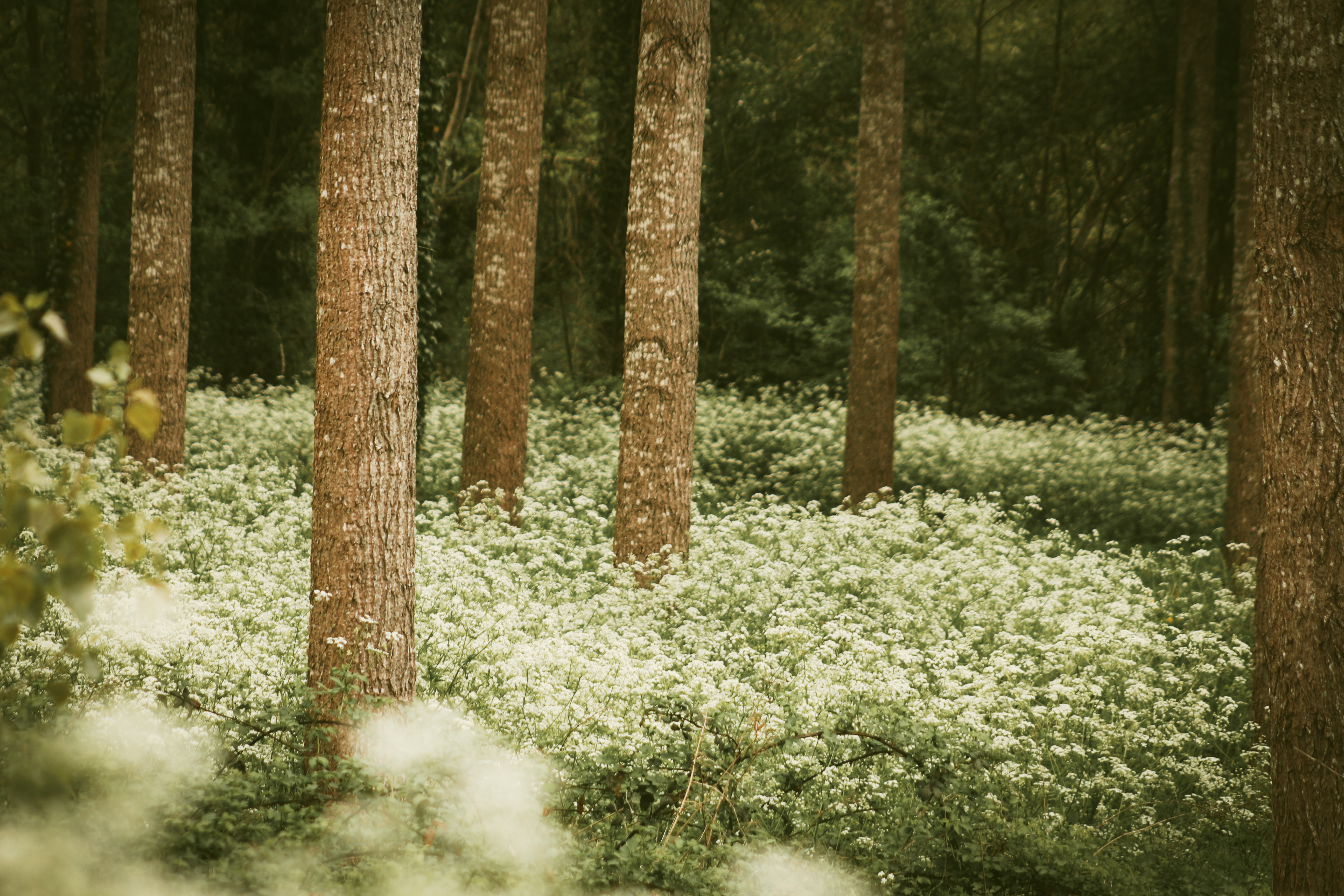
Springtime in La Double, April 2014, Photo: J Lamb
By August 25, 1940, three hundred thousand displaced people in France returned to their homes. Nearly thirty thousand remained in La Dordogne, which was considered safe, although it was not without its problems.[10] October 8, 1942, the deportation of Jews to Auschwitz begins in La Dordogne from the villages nearest the line of demarcation. La maquis did not become a factor directly dealt with by the German troops until 1942. However, this is not to say there did not exist occasions when the German’s would enter villages in unoccupied France. They did. They would come there and demand to see a list of the Jews who were living in the village. They would kill the person who gave them the list then capture all the women and children and deport them. If there were no Jews found, they would terrorize the village.[11]
In the meantime the Vichy did what it could to ascertain which individuals living in villages, such as Riberac, were doing to assist the Resistance. For this, the Vichy relied on collaboration from local business people whose work put them in contact with several members of the public. In Riberac, it was the chemist. A local woman, who was 87 when she told me her stories, recalled what she remembered of suspected collaborators in Riberac.
I met Madame Bessine after renting an atelier space located just upstairs from her home. From time to time we greeted one another as I stood looking out from the second story window over the courtyard of the church she passed though when on her way out to tend her garden. She is devoted to her daily routine and to greeting all who pass by with a smile. She was seventeen years old when the line of demarcation divided La Dordogne from other departments. Her father and husband were both members of la maquis.
Madam Bessine’s Garden, June 2010 Photo J Lamb
She lived in Riberac, where she and her mother grew vegetables to sell at the local market, “I am not going to say it was the chemist, but I think it was. No! I know it was him! Everyone knew it was him. It was obvious. He was given gifts. He was suddenly wealthy. And, at the end of the war, he suddenly disappeared.” [12]
A view of Riberac from the market, April 2014 Photo J Lamb
Such actions had consequences. German troops arrived in Riberac soon after the incident. They questioned every male in town — including Christopher.
“I did not know what was happening. I knew la maquis had destroyed the Chemist’s building the night before, but what did that have to do with me? Nothing. This is what I thought when the German’s were asking me questions. It did not occur to me that the questions meant anything, and they didn’t. The questions were strange. They asked me if I was related to the governor of Madagascar. I said, ‘No’ but they arrested me and two of my friends.”[14]
After nearly three years of utilizing France’s resources, Germany was in need of industrial workers. Its troops were tired and units growing thin. The more countries the Nazis invaded the more soldiers Germany required to support its over-extended reach. Along with this were battles raging with British forces — and of course a handful of resistance fighters in La Dordogne. Germany knew by this time it was facing a far bigger problem. In what is perceived to be a gesture of retaliation, following the first American air attack, German troops launch a campaign of terror just within the line of demarcation.
On November 9, 1942 several thousand German troops marched into Riberac putting up barricades to block the roads. Some of the soldiers went to the La Double where they set fire to people’s homes and to the forest. They were after la maquis. Twenty people were gunned down in Riberac and from La Double, 250 more are arrested – 43 of which were sentenced to obligatory service, the rest were deported. In a village only three kilometers outside of Riberac, in St-Martin-de-Riberac, all those who were arrested were taken to a field and made to walk all day, barefoot, in a circle, one meter by one meter. If they stopped, the German’s killed them.[16]
“Atlas Historique .” Carte de la France 1940 a 1944. http://www.atlas-historique.net/1914- 1945/cartes_popups/France1940-44GF.html (accessed 08 31, 2010).
Bessine, Madame, interview by Jeanette Lamb. Riberac, France.Translated by Ellie Hesse Mana Sacho. Riberac, La Dordogne, (09 01, 2010).
Cadroas, Peirre. Resistances Chronique de l’histoire 1939-1945. Riberac: Cadroas, Peirre, 2005. Cadrosas, Pierre, interview by Jeanette Lamb. Riberac, France. (09 07, 2010).
Davidson, James. After the Fact The Art of Historical Detection. New York, New York: The McGraw-Hill Companies, 2005. Fanlac, Pierre. What to see in Dordogne Perigord. Perigord: Pres la tour de Vesone, 1980.
“Government as a Step Toward Self-Rule.” The Public Quarterly 7 (1943): 527-541. Gaston, Jeze. “The Economic and Financial Position of France in 1920.”
The Quarterly Journal of Economics 2 (1921): 175-214. Giff, Steve. Interview by Jeanette Lamb. St. Sevrein, France. (08 16, 2010). Gottschalk, Louis. “Our Viche Fumble.”
The Journal of Modern History 20 (1948): 47-56. Gurvitch, George.
“Social Structure of Pre-War France.” The American Journal of Sociology 48 (1943): 535-554. Hammer, Ellen.
“Hindsight on Vichy.” Political Science Quarterly 61 (1946): 175-188.
Hoffman, Stanley. “Collaborationism in France During World War II.”
The Journal of Modern History 40 (1968): 375-395.
Jennings, Eric. “Last Exit from Vichy France: The Martinique Route and the Ambiguities of Emigration.” The Journal of Modern History 74. , June 2002: pp. 289-324.
Kammerer, Gladys. “The Political Theory of Vichy.” The Journal of Politics 5 (1943): 407-434.
Kelly, Donald. Faces of History. New Haven & London: Yale University Press, 1998.
Montry, Jean. “Unoccupied France and German War Economy.” Military Affairs. Summer 1942. http://www.jstore.org/stable/1982759 (accessed 09 10, 2010).
Penaud, Guy. Andre Malraux et la Resistance. Perigueux: Editions Fanlac, 1986. —. Chroniques secretes de la Resistance dans le Sud-Ouest.










 Digital History Projects